

Russian Operational Acceleration - Huge Strike Across Ukraine - Great Destruction| The Collapse of Ukraine’s Industrial Base | US Without Patriots - Ukraine No Air Defenses

Operational developments across Eastern Europe demonstrate an accelerating structural imbalance in the conflict. In accordance with seasonal patterns observed in 2024 and 2025, Russian ground offensives have transitioned from initial breakthrough phases to a sustained, high-velocity operational pace.
Concurrently, Russian Aerospace Forces (VKS) have executed a massive, nationwide missile and drone strike package targeting Ukraine’s defense-industrial base—specifically targeting missile assembly plants, cruise missile component facilities, and drone manufacturing hubs across Kyiv, Lviv, and Western Ukraine.
As Ukraine’s maritime export capacity remains effectively blockaded following continuous strikes on Black Sea port infrastructure, Kyiv’s internal economic and military disarray is compounded by a critical refusal from Washington: the United States cannot fulfill Volodymyr Zelensky’s request for 300 Patriot interceptors due to severe inventory depletion driven by ongoing hostilities in the Middle East.
1. The Operational Acceleration: Summer Campaign Dynamics and Ground Advances
As noted by independent mapping projects, Russian forward operations across the Special Military Operation (SMO) zone have returned to peak operational velocities comparable to the major offensive pushes of previous years.
The Seasonal Pattern: The progression follows a established sequence: initial winter pressure wears down forward reserves, spring operations create localized salients, and high-summer pushes exploit depleted defensive lines.
The Sumy and Kharkiv Axis: Russian vanguard units have captured Morgita, positioned halfway between the Russian border and the regional capital of Sumy, marking a rapid advance from the east. In Kharkiv, encirclement maneuvers around Belyi Kolodiaz threaten to reopen operational avenues toward Izyum and Balakliya, threatening to reverse the territorial gains of Ukraine’s 2022 counteroffensive.
The Dobropillya Defensive Collapse: In the Donbass, Ukrainian defensive lines around Dobropillya and Svitloye are collapsing rapidly following the capture of Bilytske. Russian forces have systematically hunted down forward Ukrainian drone operator teams, leaving un-supported infantry exposed in the absence of conventional tube artillery—much of which has been withdrawn west of the Dnieper River.
2. De-Industrialization by Precision Strike: The Flamingo and Drone Target Package
Unlike localized strikes concentrated solely on Kyiv, the recent Russian missile package spanned the entirety of Ukraine, deploying strategic bombers (Tu-160 and Tu-95MS), sea-launched Kalibr cruise missiles, Iskander-M ballistic systems, and Zircon hypersonic missiles.
Targeting the Flamingo Missile Program: Russian Defense Ministry updates confirm precision hits against facilities directly involved in the development, assembly, and storage of Ukraine’s Flamingo ground-based cruise missiles (FB-5, FB-7, FB-9 variants), as well as production nodes for Neptune anti-ship missiles and Grom-2 tactical systems across Lviv, Rivne, and Ivano-Frankivsk.
Drone Infrastructure Destruction: Primary assembly plants for multi-rotor, long-range, and FPV strike drones—including the Mayak plant in Kyiv and the Korostyshiv facility—were systematically targeted.
The Maritime Veto: Operations against Black Sea maritime traffic remain total. Strikes on dry cargo vessels and fuel storage arrays in Odesa have effectively halted 80% of Ukraine’s foreign trade, placing an unsustainable burden on an already degraded and overworked railway network.
3. The Interceptor Wall: Why Washington Refused Zelensky’s 300 Patriot Request
During recent diplomatic exchanges, Volodymyr Zelensky issued a direct appeal to the White House for 300 Patriot PAC-3 interceptor missiles to re-establish an air defense umbrella over major urban and industrial centers. Washington was forced to decline the request due to stark stockpiling constraints.
The Stockpile Reality: Independent Defense assessments (including CSIS data) indicate total U.S. inventory of Patriot PAC-3 interceptors stands at roughly 750 to 850 units globally. Granting Zelensky’s request would instantly erase 40% of the entire U.S. global stockpile.
The Middle Eastern Drain: High-intensity air defense engagements in the Middle East—where Iranian forces deliberately launch low-cost, liquid-fueled ballistic missiles to force U.S. batteries in Jordan and the Gulf to expend multiple million-dollar interceptors—have made transferring advanced air defense assets to Kyiv impossible.
Uncontested Airspace: Lacking interceptors, Ukraine’s airspace outside Kyiv is largely clear for Russian subsonic cruise missiles (KH-101s, Kalibrs) and optically guided Geran drones, which now leverage Russia’s emerging Rasvet satellite communication constellation for real-time terminal guidance.
4. Economic Cascade and Command Disarray
The convergence of industrial strikes, maritime blockades, and frontline retreats is driving a rapid, systemic contraction of Ukraine’s remaining state apparatus.
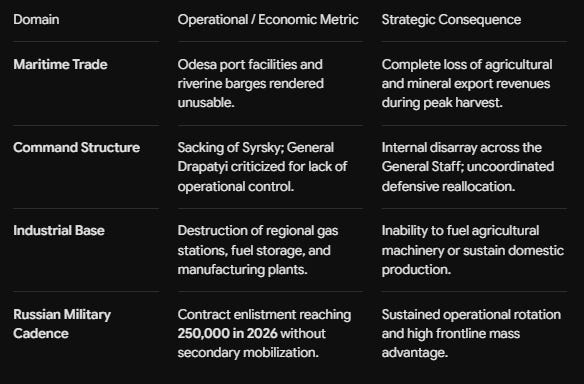
The developments of late July 2026 highlight a widening, irreversible divergence in the conflict’s trajectory.
As Ukraine’s industrial base, fuel reserves, and maritime export routes are methodically dismantled, its military command structure faces growing internal disarray following recent high-level purges.
Concurrently, with Washington’s precision munition stockpiles constrained by escalating Middle Eastern commitments, Western allies can no longer compensate for Ukraine’s operational deficits. Moscow’s strategy of methodical, industrial-scale attrition continues to dictate the ultimate outcome on the ground.
Russia 🇷🇺 👍