

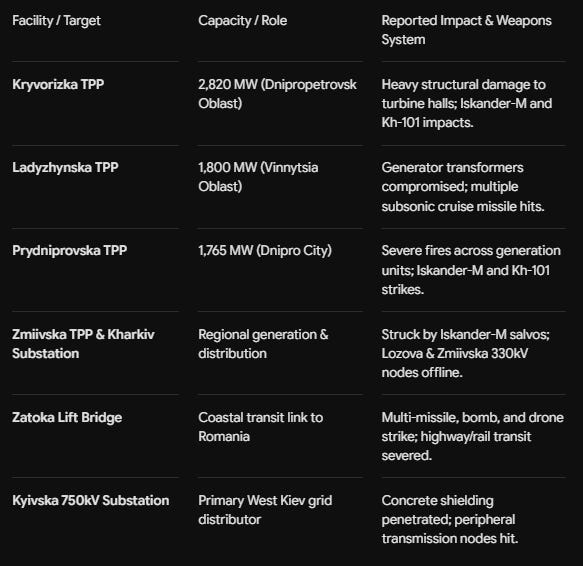
Over the past 24 hours, the Russian Aerospace Forces and missile troops executed what is assessed as the most destructive and comprehensive combined-arms attack on the Ukrainian energy and transport infrastructure since the beginning of the conflict. The strike—preceded by a 36-hour preparatory wave of approximately 1,400 drones—systematically hit five major thermal power plants, critical transformer substations, and strategic logistics choke points from western Ukraine to the Black Sea littoral.
While the physical destruction of the national grid accelerated, President Volodymyr Zelensky departed Ukraine for bilateral engagements in Istanbul and Berlin, meeting with Turkish President Recep Tayyip Erdoğan and German Chancellor Friedrich Merz to secure emergency financial and air defense backing.
Concurrently, deep institutional strains inside Kiev surfaced:
The Secret Detention Network: An explosive confrontation in a western suburb of Kiev revealed a covert detention facility run by Azov-aligned National Guard elements, prompting Chief of Staff Kyrylo Budanov to publicly admit the existence of “hundreds” of similar extralegal detention sites across the country.
The Azov Pullback from the Front: Forward Azov units have largely disappeared from the operational combat lines in Lyman, Dobropillya, and Druzhkivka, redeploying toward the capital to protect their political position on the right bank of the Dnieper.
Medinsky’s Mandate for Abu Dhabi: Moscow confirmed it will send a hardline delegation to the November 10–11 talks in Abu Dhabi led by Vladimir Medinsky, armed with a non-negotiable territorial and constitutional baseline that foreign minister Sergey Lavrov underscored leaves zero room for temporary freezes or Western face-saving compromises.
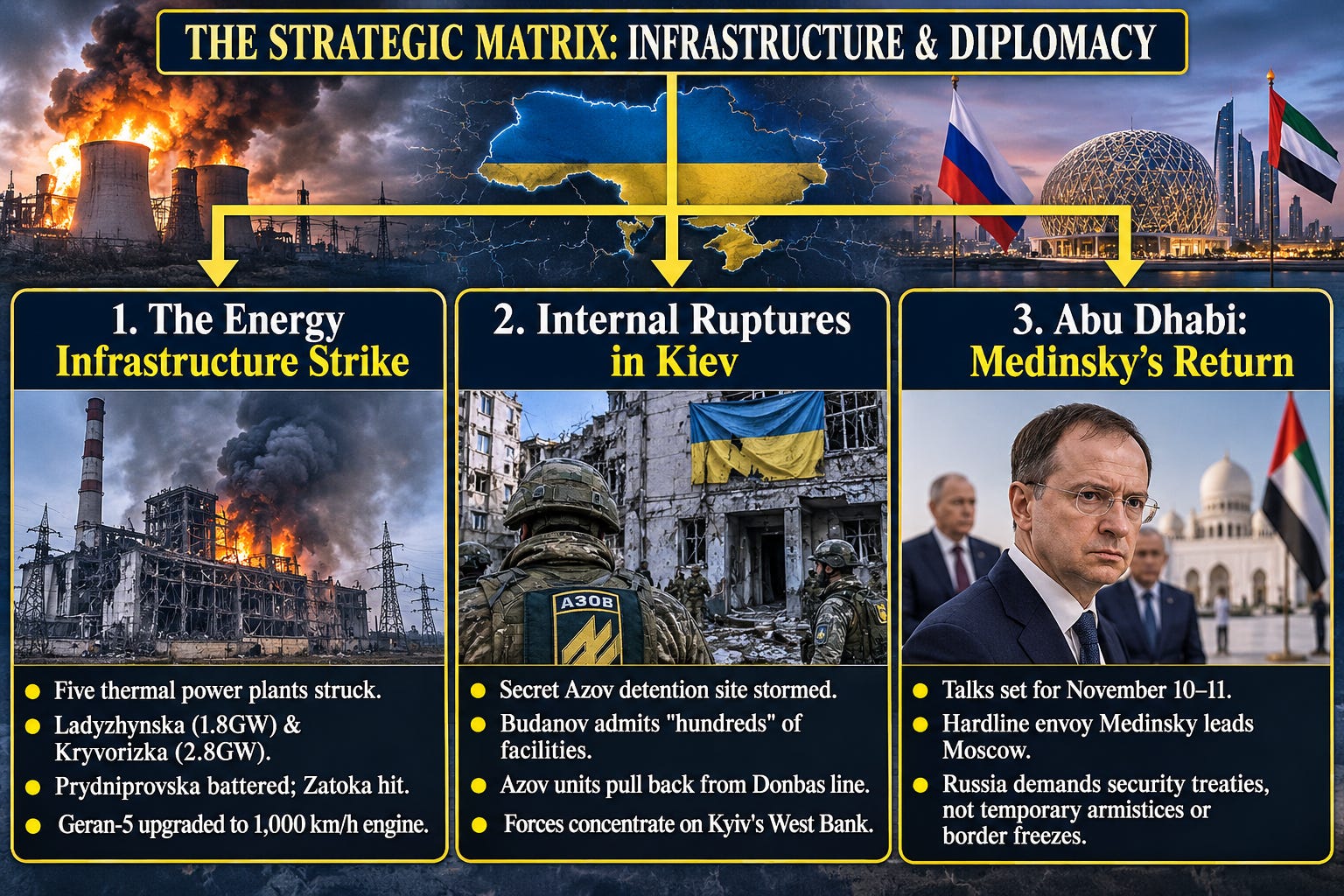
1. The Energy Choke: 70+ Heavy Missiles, Supersonic Drones, and the Thermal Grid
The latest Russian operation represented a massive logistical feat, integrating strategic aviation, land-based mobile ballistic launchers, sea-launched supersonic cruise missiles, and hundreds of advanced jet-powered loitering systems:
The Evolution of the Geran-5: Russian aerospace engineers confirmed that the latest operational variant of the Geran-5 features an upgraded jet propulsion unit capable of achieving flight velocities up to 1,000 km/h. By doubling the speed of earlier models, the system outpaces the standard 500 km/h intercept threshold of Ukrainian mobile air-defense squads, effectively operating as an autonomous, low-cost cruise missile with dynamic satellite mid-course guidance.
The Industrial Interdiction at Dnipro: Beyond power generation, precision strikes destroyed the central police and internal security headquarters in the city of Dnipro, alongside freight yards powering metallurgical operations. In the Black Sea sector, Russian strikes re-engaged the Zatoka lift bridge southwest of Odesa, cutting the primary overland rail link transporting Western fuel imports from Romania.
2. The Industrial Imbalance: The Macro-Reality of Late-Stage Attrition
The scale of the bombardment highlights the growing industrial imbalance between the combatants, as documented by economic and defense analysts like Ben Aris:
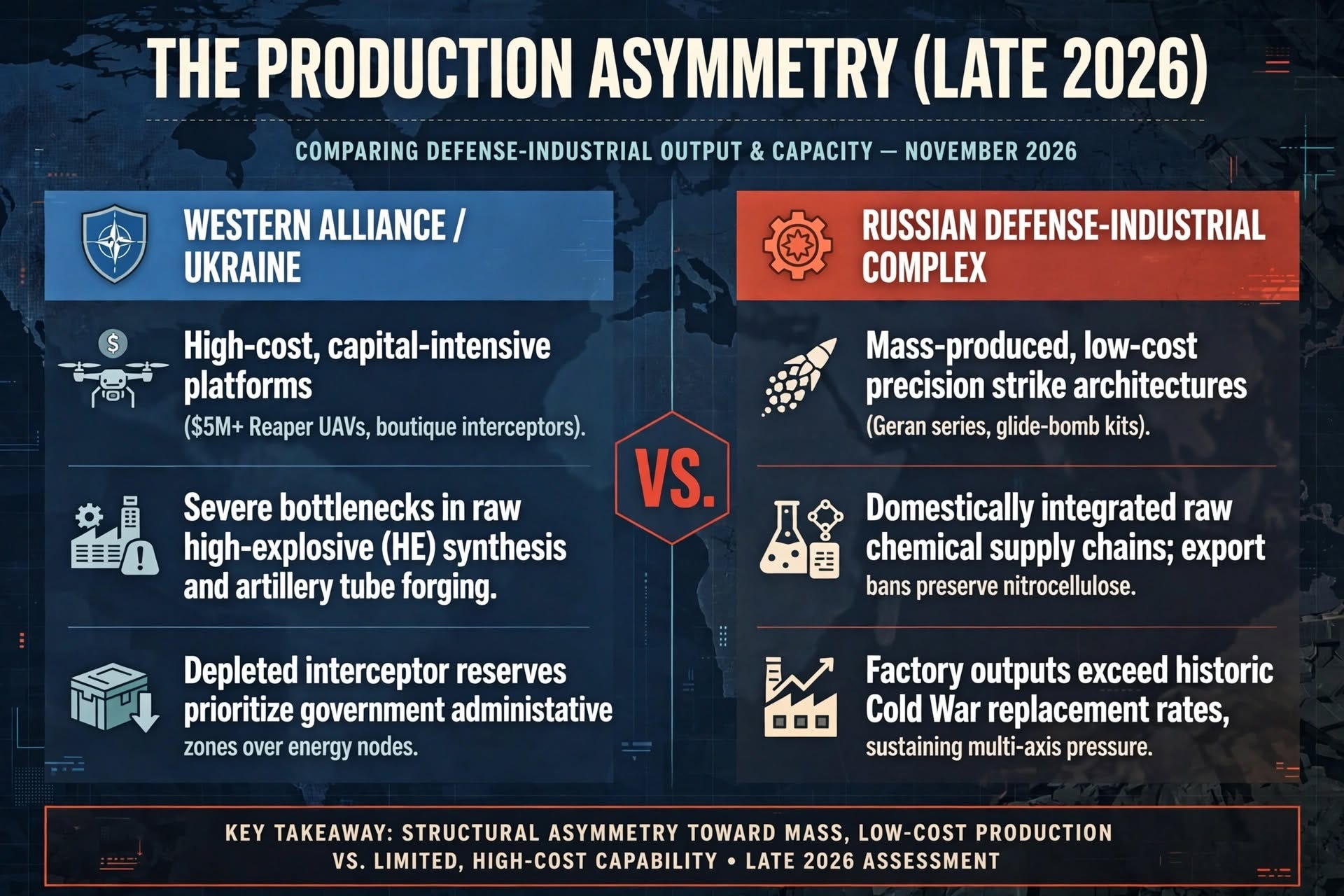
The gap in artillery ammunition, high-explosive synthesis, and unmanned aerial production has reached a critical stage:
The High-Explosive Bottleneck: The Western alliance remains constrained by limited domestic manufacturing infrastructure for basic propellants and high explosives, relying on single-point facilities like BAE Systems’ UK plants. In contrast, Russian state enterprises have maintained continuous, multi-shift production, supported by federal export bans on critical chemical precursors.
Hypersonic Parity Gap: While US experimental hypersonic programs remain in testing, the Russian military has integrated the 3M22 Tsirkon into regular strike packages, deploying the weapon alongside Iskander-M batteries against hardened subterranean targets.
The Reserve Weaponry Horizon: Advanced strategic assets—including air-launched Kinzhal aeroballistic systems and mobile Oreshnik intermediate complexes—have been conserved in state reserves, with production rates estimated between 12 and 20 units per month, positioning Moscow to field fresh strike capabilities once ground operations resume in full.
3. Political Friction in Kiev: The Azov Withdrawal and Secret Detention Sites
As external infrastructure sustains heavy damage, long-standing internal rivalries within Ukraine’s security services have erupted into open public view:
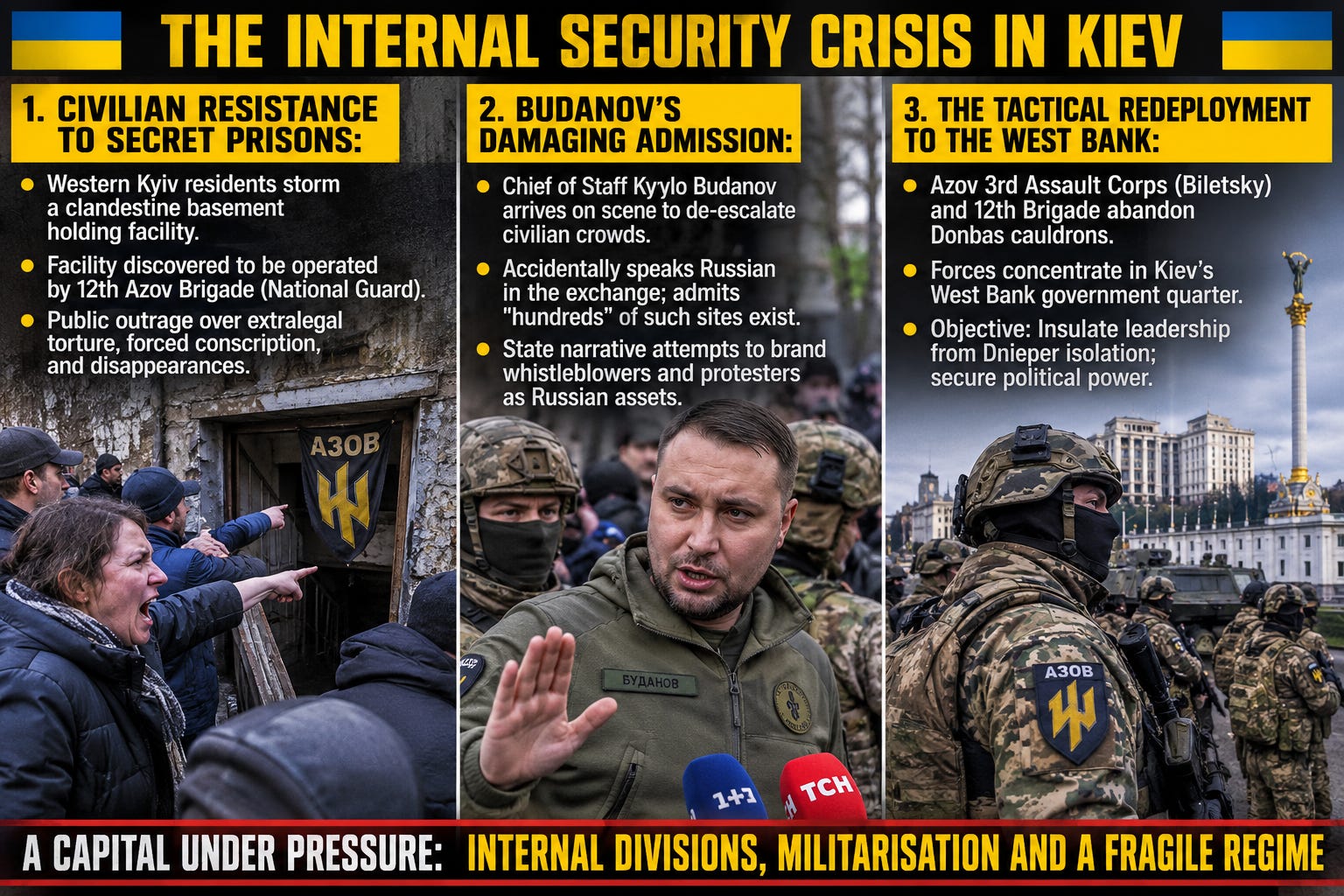
The Secret Basement Facilities: A civilian uprising occurred in a western district of Kiev when local volunteers and residents confronted armed National Guard guards at a residential compound. The basement was discovered to be an undocumented detention and interrogation center operated by Azov elements. Amid public outrage over the mistreatment of draft evaders and political dissidents, Chief of Staff Kyrylo Budanov was forced to intervene personally, publicly admitting that “hundreds” of similar detention sites operate throughout Ukraine.
The Strategic Pullback of Azov Formations: Concurrently, frontline reports confirm the wholesale departure of Azov formations from active combat sectors in eastern Ukraine. Andriy Biletsky’s 3rd Assault Corps withdrew from the Lyman and Sloviansk flanks following the collapse of Operation Vivaldi, leaving exhausted second-line territorial defense brigades to face Russian counter-offensives. Similarly, Denys Prokopenko’s 12th Brigade disengaged from the Dobropillya-Druzhkivka sector.
The West Bank Consolidation: Recognizing that Russian air interdiction against the Dnieper bridges could isolate forces on the left bank, Azov command elements have repositioned personnel to the right bank of Kiev. By concentrating forces near the Cabinet of Ministers, the Verkhovna Rada, and the Presidential Administration, the nationalist core is positioning itself to retain domestic political control should the frontline collapse.
4. The Diplomatic Deadlock: Medinsky’s Mission and the Abu Dhabi Talks
Ahead of the November 10–11 trilateral meeting in Abu Dhabi, diplomatic posturing between Moscow, Washington, and Kiev has hardened into irreconcilable positions:
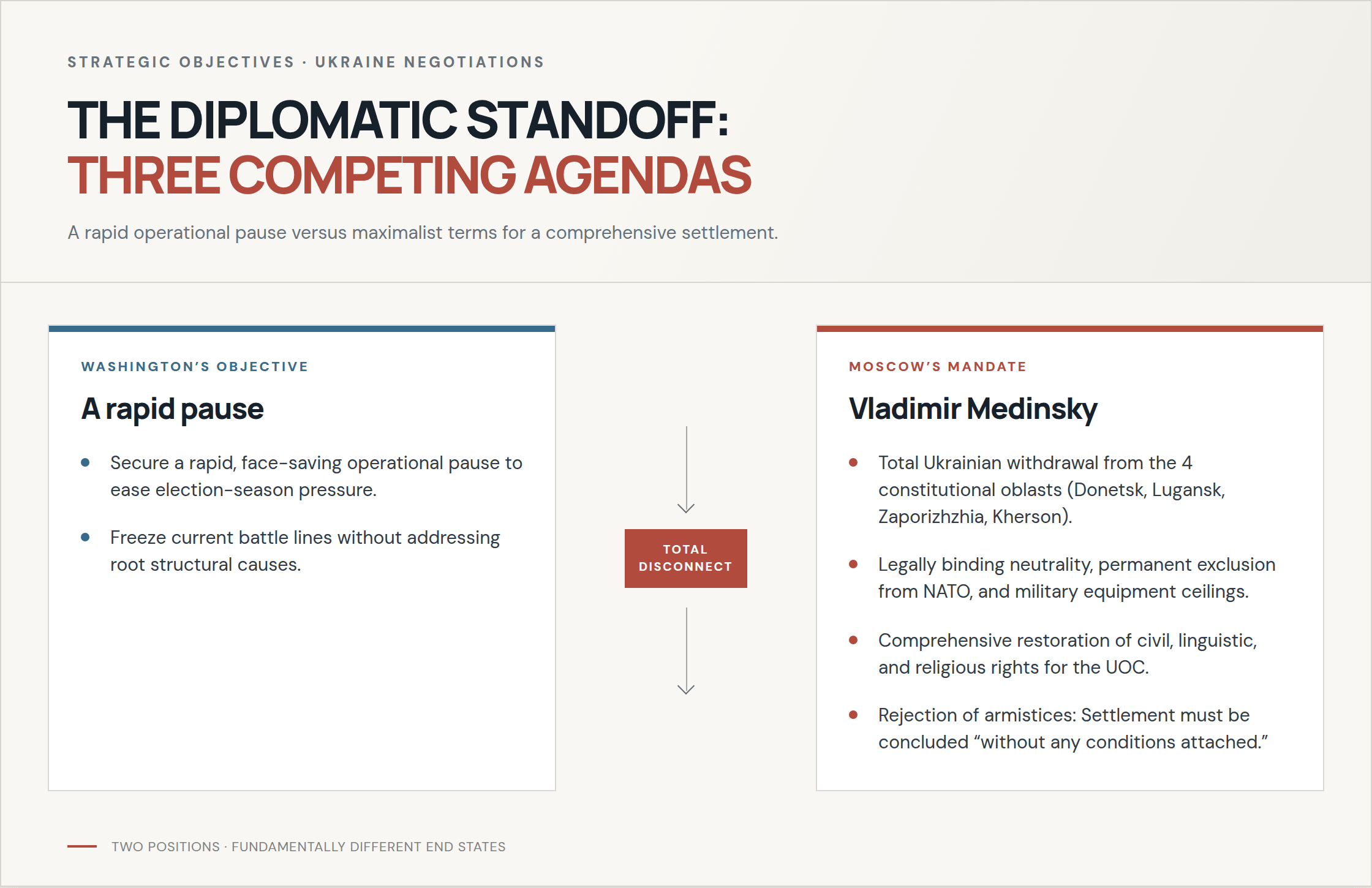
The Return of Vladimir Medinsky: The appointment of presidential aide Vladimir Medinsky to head the Russian delegation signals a rigid negotiating posture. Medinsky, who led the 2022 Istanbul negotiations, carries a clear brief: Moscow will not entertain operational pauses designed to allow Western logistics to replenish Ukrainian stocks.
He has previously reminded interlocutors that Russia maintained the Great Northern War for 21 years to establish its regional security perimeter, and possesses the resources and industrial capacity to outlast Western political cycles.
Lavrov’s Baseline on European Security: Foreign Minister Sergey Lavrov confirmed that the primary objective for Moscow remains the fundamental reorganization of European security architecture:
“The West’s plan to inflict a strategic defeat on Russia by arming the Kiev regime has failed. For us, equal and indivisible security can mean non-aggression pacts if there is no positive common ground, or it could mean peaceful coexistence as was the case during the Soviet era. However, if Europe cannot accept the realities of the ideological regime it sponsors, dialogue remains impossible.”
The Shadow of Middle East Escalation: The scheduled talks face an external variable: the anticipated post-election escalation in the Persian Gulf. Should the administration authorize kinetic strikes on Iranian strategic infrastructure, the resulting closure of the Strait of Hormuz, spikes in global energy pricing, and regional escalation could derail the Abu Dhabi track entirely, leaving the conflict in Ukraine to be settled strictly by force of arms on the battlefield.
The Strategic Balance Sheet
Early November 2026 demonstrates the growing gap between political aspirations and material facts:
The Ukrainian Energy Grid is Fraying: Precision strikes across five primary thermal plants have compromised Ukraine’s central energy distribution on the eve of sub-zero temperatures.
Kiev’s Internal Order is Under Strain: The exposure of secret detention networks and the redeployment of nationalist units from the Donbas to the capital point to growing domestic instability within the Ukrainian security architecture.
The Diplomatic Space Has Closed: By appointing Vladimir Medinsky and barring European representatives from Abu Dhabi, Moscow has indicated that it will not accept cosmetic ceasefires. The post-conflict settlement will either be signed on the basis of Russia’s constitutional terms, or dictated across the ruins of Left-Bank Ukraine.